The Water a Heat Pump Is Meant to Make: Monitoring Condensate on UK Retrofits
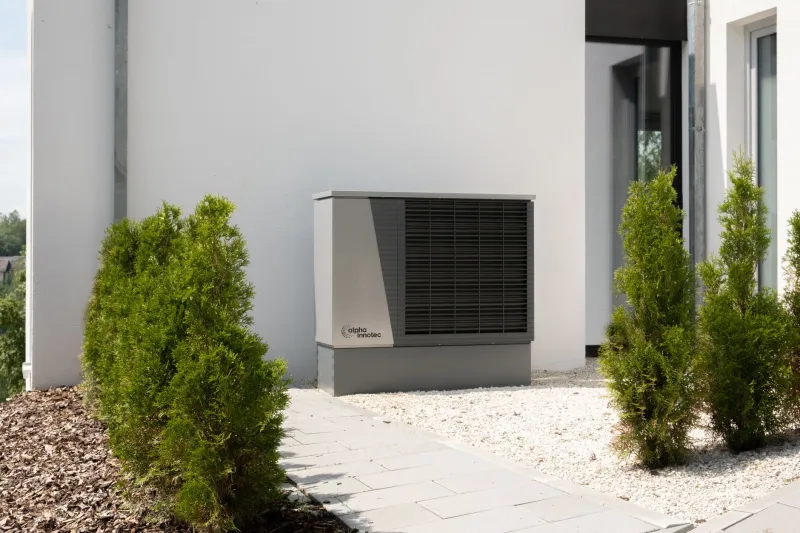
When a boiler is replaced by a heat pump, the water map of a home changes. The familiar risks remain — a failed cylinder, a weeping joint, a stuck valve — but a new and less understood flow appears: condensate. It is water the system is meant to produce, and that is precisely why it can be missed by conventional leak protection. A standard alarm reacts to unexpected water on a floor. A heat pump retrofit needs monitoring that understands expected water, unexpected water and the difference between the two.
A planned flow, not a fault
Heat pumps extract heat from outside air, and in doing so they cool the outdoor heat exchanger. Moisture in the air condenses on it. In heating mode, that water must be drained away continuously, and during defrost cycles it can be released in short bursts. Air-to-air systems may also produce condensate from indoor units. The volume is usually modest, but it is persistent, seasonal and highly dependent on weather. A cold, damp week can produce far more condensate than a dry, mild one.
This makes condensate fundamentally different from a burst pipe. It is not a sign of failure in itself. The risk lies in the route: the pipe, trap, pump, neutralisation device and soakaway that carry it away from the building. If any part of that chain is obstructed, frozen or disconnected, water will find another path — often into a ceiling void, an internal wall, a floor slab or the foundations.
Mapping the route before monitoring it
A monitoring plan should begin with a simple diagram. For a typical UK retrofit, the route may include the outdoor unit drain, a condensate pump where gravity drainage is not possible, a trapped connection to an internal soil and vent pipe, a neutralising device where acidic condensate must be treated, and an external soakaway or drain. In some installations, a secondary route serves an indoor unit or a hot water cylinder arrangement.
The diagram should record every joint, change of direction, low point and point of discharge. It should also note which sections are inside the thermal envelope and which are exposed. A pipe that leaves a heated space and runs across a cold loft or an external wall is a different risk from one that falls directly to a gully. The same applies to soakaways: a blocked or saturated soakaway can back up water into the pipework, and the first sign may be dampness at the base of a wall rather than a visible overflow.
Blockage, freeze and joint failure
Three failure modes deserve particular attention in a heat pump retrofit.
The first is blockage. Condensate carries dust, biological growth and debris from the heat exchanger. Small-bore pipework and traps can silt up over time. A blockage may not stop the system immediately, but it raises the water level in the trap or pipe until it overflows or backs up into the unit. In retrofits, long horizontal runs and multiple bends increase the chance of a low point where debris collects.
The second is freeze-up. UK winters can deliver the combination that matters most: low temperatures, wind exposure and intermittent operation. A condensate pipe that runs outside without adequate fall, insulation or a suitable diameter can freeze at the outlet or in a shallow section. The heat pump may continue to run, and the water then has nowhere to go. Freeze-up is often intermittent, which makes it easy to dismiss as a one-off.
The third is joint or pipework failure. Retrofits frequently involve routing new pipework through existing fabric. A joint may be under stress where it passes through a wall, or a flexible connection may be pulled tight during installation. Movement, thermal cycling and vibration can then open a slow weep. Because condensate is produced gradually, the resulting dampness may be attributed to condensation or a roof leak rather than to the drainage route itself.
Instruments that understand context
A simple water alarm on the floor beside the outdoor unit is useful but limited. It will not see a blockage building up inside a trap, and it will not distinguish a normal defrost discharge from a leak inside a ceiling void. A more effective approach combines three types of observation.
First, flow or presence detection at the discharge point. A sensor that confirms condensate is leaving the system when the heat pump is producing it can reveal a blockage before water backs up. Second, moisture detection along the internal route — in the loft, at wall penetrations and beneath the indoor unit or cylinder cupboard. Third, temperature monitoring on exposed pipe sections, which can provide an early warning of freeze risk before the route is blocked.
Context matters. A smart system should be configured with the heat pump's operating pattern, not simply with a generic water threshold. Short pulses during defrost are normal. A continuous trickle at a time when the system should be dry is not. The aim is not to eliminate alerts but to make them meaningful.
A first-season routine
For the first heating season after a retrofit, a monthly inspection is prudent. Check the outdoor discharge point for ice, debris or staining. Confirm that the trap holds water and that the pipe has a continuous fall. Inspect any internal route for damp patches, swelling or cold spots. Where a condensate pump is fitted, listen for frequent cycling and check the reservoir for silt.
After the first winter, the routine can move to a seasonal check before the cold weather and a further check after it. Heavy rainfall and saturated ground should prompt a look at the soakaway, because a soakaway that cannot accept water will send it back along the route. Any change in the sound of the system, the appearance of the discharge or the humidity in the surrounding space deserves investigation.
Escalation thresholds
Not every damp mark is a leak, and not every leak is an emergency. A single wet patch after a defrost cycle may be normal. Water appearing where the route has no joint, or dampness that persists when the heat pump is idle, is not. Repeated freeze alerts, a discharge that stops while the system runs, or any sign of water in a ceiling void should be treated as a fault to investigate promptly. In a retrofit, the cost of a slow condensate escape is often hidden in the fabric of the building rather than in the heat pump itself.
Heat pumps are designed to manage water, not to avoid it. Protection therefore depends on knowing where that water is meant to go, and on monitoring the route with the same care as the appliance.