What the Tundish Tells You: Monitoring an Unvented Hot Water Cylinder Before It Fails

Photo: unvented hot water cylinder airing cupboard UK plumber tundish, via img.freepik.com
In a great many British homes the hot water cylinder sits where nobody looks: an airing cupboard off the landing, a purpose-built enclosure, or a loft that is visited twice a year for the Christmas decorations. That position is convenient for pipework and awkward for observation, which is precisely the combination that allows a slow failure to run unremarked until a ceiling gives way.
An unvented cylinder differs from the older vented pattern in one important respect. It stores water at mains pressure, commonly between 3 and 6 bar, and holds it at 60°C or above for legionella control. In effect it is a pressure vessel installed inside the dwelling, governed by Part G3 of the Building Regulations in England and Wales, with equivalent provisions in Scotland and Northern Ireland. Installation, commissioning and service work must be carried out by a competent person holding the appropriate G3 qualification. That regulatory line matters for this article, because a good deal of cylinder monitoring is physical inspection, not telemetry.
A pressure vessel, not a tank
A 200-litre cylinder heated to 65°C holds a considerable quantity of stored energy, and its components are expected to manage both temperature and pressure without intervention. When that management fails, the consequences divide into two categories. There is the slow leak, typically at a compression joint, an immersion heater gasket or the base of the unit where condensation has quietly done its work. Then there is the uncontrolled discharge, where a relief device operates or a component ruptures and water leaves at mains pressure.
The reassuring part is that unvented installations are designed with visible early warning built in. The tundish, the small funnel-shaped fitting on the discharge pipe, exists to make relief valve operation obvious. A dry tundish is the normal condition. A steady trickle, hot or cold, means something is passing and needs attention.
The three checks that catch most faults
Observe the tundish. Any continuous flow is a fault until proven otherwise. A brief drip during the heating cycle can indicate thermal expansion, particularly where the expansion vessel is undersized or has lost charge, but a persistent stream points to a passing temperature and pressure relief valve, a failed expansion vessel or excessive incoming pressure. Photograph it, note the time, and call a G3-qualified engineer.
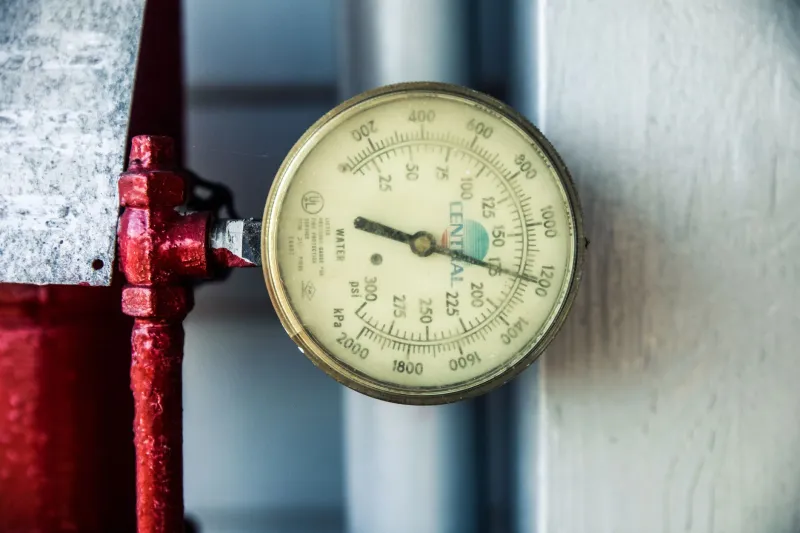
Verify the expansion vessel charge. This is among the most common causes of nuisance discharge in UK installations. The vessel contains a diaphragm with a pre-charge, usually around 3 bar to suit the pressure reducing valve setting. Over several years the charge escapes through the Schrader valve or the diaphragm perishes. A check with a suitable gauge, followed by recharging in line with the manufacturer's instructions, is straightforward. If water emerges from the valve, the diaphragm has failed and the vessel must be replaced rather than recharged.
Exercise and inspect the relief valve and discharge pipe. The temperature and pressure relief valve should be checked as part of an annual service, and replaced if it does not reseat cleanly. The discharge pipe, designated D2, should be of metal in the accepted configuration, fall continuously away from the valve, and terminate safely where discharge cannot scald or damage. A blocked or incorrectly terminated discharge pipe is one of the quieter hazards in a domestic system, because nothing appears wrong until the valve operates and the water has nowhere to go.
Reading the clues: scale, corrosion and temperature
In hard water areas, scale accumulates on immersion elements and around hot outlets. Audible popping from the cylinder often accompanies a heavily scaled element, and the unit becomes slower to heat. Stored water should not be run cooler to save energy; below 60°C the risk of legionella growth rises, and the usual arrangement is a thermostatic mixing valve at the outlet to bring water down to a safe temperature at the tap. Where a sacrificial anode is fitted, its condition belongs on the service schedule, and where the cylinder is stainless steel the coil and welded connections deserve particular attention in areas of aggressive water.
Corrosion clues are worth learning. Green staining at copper joints, white crusting at stainless connections, rust marks at the base of the unit or damp insulation all suggest a problem that predates any visible leak.
Where smart sensing earns its place
Cylinder monitoring is not a substitute for the physical routine described above, but a small number of devices materially improve the odds of catching a fault early.
- A leak sensor placed in the cylinder tray or clipped at the tundish catches discharge events in a loft where nobody would otherwise hear running water. Positioning it at the cylinder rather than only beside the boiler is the point.
- Flow monitoring at the incoming main can identify continuous low-level demand, the signature of a passing relief valve or a slow fill, especially overnight when legitimate use should be nil.
- A temperature probe on the discharge pipe can distinguish a short expansion drip from sustained hot discharge.
- An automated shut-off valve on the cold mains feed limits the make-up water available to a leaking system and can reduce the duration of an escape.
It is worth being precise about that last point. A shut-off valve cannot empty a cylinder that has already failed; 200 litres are stored above the valve, and those litres will find their way out. What the valve does is prevent the incoming main from feeding the leak indefinitely, which is often the difference between a soaked floor and a collapsed ceiling.
Where sensing does not help
No sensor will recharge an expansion vessel, exercise a relief valve or remove scale. A pressure transducer cannot see internal corrosion, and a leak sensor will not report a fault that has not yet produced water. The cylinder rewards a physical routine, and technology should be treated as an additional layer rather than a replacement.
A simple annual schedule
Diarise the G3 service, then add the following checks, most of which take a few minutes: confirm the tundish is dry; inspect the cylinder, insulation, joints and base for staining or damp; verify the expansion vessel charge; operate and reseat the relief valve under supervision; confirm the discharge pipe termination is clear and safe; check stored and delivered temperatures; test every linked sensor with a damp cloth and confirm the alert reaches a phone; and record the results alongside the service paperwork.
Those records matter at claim time. Insurers increasingly ask for evidence of maintenance when a water escape is investigated, and a dated log with photographs is far more persuasive than a recollection that the cylinder was looked at some years ago.
The cylinder is quiet, pressurised and often out of sight. A short routine, a sensor in the right place and a competent engineer once a year will keep it that way.