A Gauge in the Cupboard: Why Mains Pressure Deserves a Place in UK Home Water Protection
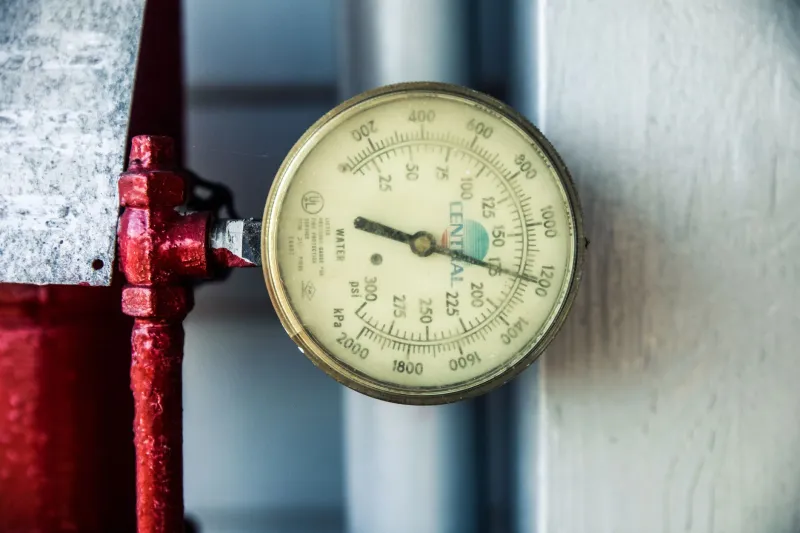
Smart water protection in British homes has largely coalesced around flow. A device counts litres, learns a household routine and closes a valve when the pattern looks wrong. That is a sensible foundation, but it is not a complete reading of the system. Pressure is the force that stresses joints, fatigues washers and flexi hoses, and turns a minor weep into a visible escape. A flow sensor tends to notice the consequence; a pressure sensor can notice the conditions that make the consequence more likely.
The limits of watching litres alone
Flow-based shut-off is designed around thresholds. A property may have a small, persistent loss that never quite reaches the trigger point, or a series of pressure surges that move no water at all. Neither is a leak in the conventional sense, yet both can shorten the life of pipework and fittings. In a home with a combination boiler or an unvented hot water cylinder, pressure is not an incidental reading. It is part of the appliance's operating envelope, and it is already being managed by valves, expansion vessels and controls that many occupants never see.
Adding pressure data to a smart water installation does not replace the valve. It gives the valve context. A sudden flow event at 03:00 is more informative when it coincides with a pressure drop. A valve that closes on flow alone may be reacting to a burst flexi hose; a system that also sees sustained high pressure can flag the conditions that may have contributed.
What pressure data can reveal
A useful monitor should record more than a single snapshot. The static pressure overnight, when demand across the local network is low, provides a baseline. Peak pressure during the day shows how far the supply rises. Short, sharp transients, often caused by water hammer when appliances or outside taps close abruptly, are worth counting rather than averaging away. A pressure trace that drifts upward after a pressure-reducing valve has been set can indicate that the valve is passing or that its strainer is obstructed.
For a homeowner, the practical questions are straightforward. Does pressure remain within the limits stated by the boiler or cylinder manufacturer? Does it rise excessively at night? Are there repeated spikes when the washing machine or an outside tap is used? Does pressure fall when no water is being drawn, suggesting a loss downstream of a check valve or pressure-reducing valve? The answers help an installer decide whether the issue is network-side, appliance-side or internal.
The British mains is not a constant
Mains pressure in the UK is not guaranteed at a fixed figure. It varies by region, elevation, local demand and the condition of the distribution network. Properties at the end of a long supply pipe, or on higher ground, may see lower pressure; others may receive considerably more than the appliances expect. Night-time pressure can rise as demand falls, and nearby industrial or commercial use can introduce its own patterns. This is why a generic threshold is rarely enough. The relevant limits are those in the appliance instructions and the assessment made by a competent installer.
Older properties add another variable. Pipework that has served for decades may have been jointed and repaired in ways that are not visible. Higher pressure will not create a leak on demand, but it can accelerate wear at compression joints, taps and flexible connectors. Monitoring pressure is therefore a form of condition awareness rather than a substitute for maintenance.
When a pressure-reducing valve earns its place
A pressure-reducing valve, usually fitted after the incoming stopcock, limits the pressure delivered to the internal distribution system. In homes with unvented cylinders, the cylinder manufacturer will specify a pressure limit, commonly around 3 bar, and the associated expansion control must be correct. Combination boilers also have inlet pressure limits, and older pipework may benefit from a lower setting than a modern appliance requires. Where static pressure regularly exceeds the appliance manufacturer's limit, or sits persistently around 4 bar or more, a pressure-reducing valve is usually worth discussing with a qualified installer. The exact figure should come from the appliance documentation and a site assessment, not from a rule of thumb.
A pressure-reducing valve is not fit-and-forget. It should be serviced in line with the manufacturer's instructions, typically as part of an annual plumbing or heating service. Signs that it needs attention include downstream pressure creeping above its set point, visible discharge from a pressure-relief pipe, or a strainer that has not been cleaned for years. Monitoring downstream pressure makes those signs visible before they become a puddle in the airing cupboard.
Choosing a monitor that reads pressure properly
Not every smart water device that mentions pressure does so with useful resolution. Look for a sensor that logs at regular intervals, records minimum and maximum values, and can distinguish a sustained high reading from a brief transient. The installation point matters: a sensor upstream of a pressure-reducing valve shows what the network is delivering, while one downstream shows what the home is receiving. For most domestic protection plans, the downstream reading is the more directly relevant. Data export, clear alerting and integration with the shut-off valve are practical considerations; a pressure reading that cannot be reviewed after an event has limited value.
Pressure monitoring is not a dramatic feature. It will not close a valve by itself, and it should not be sold as a substitute for flow-based leak detection. Its value is cumulative: a record of how the supply behaves, an early indication of valve drift, and a clearer picture when something does go wrong. In a British home where the boiler, cylinder and pipework are expected to coexist for years, that quiet record is a sensible addition to the protection plan.